.webp?height=100&t=1784835632&width=150 "LSG26_LTAgentEdgeImage_DB-1313-1 (1).png")
SCB FEATURE
The Long Road to Autonomous Cargo Shipping

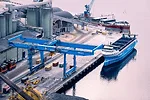
The Yara Birkeland, the world's first purpose-built autonomous, zero emissions cargo ship. Photo: Dag Frode Høyland, courtesy of Yara
While autonomous cargo ships are viewed by many as the future of maritime transportation, the industry is still working to figure out where that future begins, and where its limits might lie.
Autonomous cargo ships have made significant technological progress as artificial intelligence has rapidly advanced. Even so, the industry remains years away from replacing conventional crews on most commercial voyages. As it stands now, the technology's capabilities are limited to predictable shipping routes, rely on direct assistance from human crew, and still struggle to match human adaptability in the face of unpredictable factors like extreme weather or malfunctioning equipment.
Amy VanWagner, VP of operations for steel producer AJ Manufacturing, whose work focuses on industrial automation and predictive maintenance, said autonomous systems still fall short when conditions become unpredictable.
"For the time being, humanity's worldly experience remains critical on long-haul journeys to contend with emergencies," VanWagner says.
That's not to say that there isn't autonomous technology that hasn't already proven useful aboard cargo vessels. And in fact, many of the building blocks of autonomous shipping are already in use across commercial fleets today. Automated optimization systems powered by artificial intelligence are widely used by commercial fleets to plot efficient routes, manage fuel consumption and help avoid inclement weather. Many ships also come equipped with sensor-based monitoring to anticipate everything from potential collisions to equipment failures.
Read More: Are Self-Piloting Ships on the Way?
It's in those nuances that it becomes important to understand the distinction between a "smart ship" and an "autonomous ship." Whereas smart ships incorporate a collection of automated digital systems to optimize the decision-making of a human crew, autonomous ships are designed to operate with little to no human intervention. For the former, the technology has become ubiquitous in the modern maritime industry, while the latter is largely theoretical at scale.
That said, limited trials have yielded relatively positive results for autonomous ships in recent years. In 2022, after being retrofitted with AI systems and sensors, the Suzaku cargo ship conducted the first major demonstration of autonomous navigation through congested waters as part of a 490-mile journey off the coast of Japan. Dating back to 2023, the Yara Birkeland — the world's first purpose-built autonomous, zero-emission cargo vessel — has also completed more than 175 voyages on its 11-mile route carrying fertilizer along the Norwegian coast (albeit with three human crew members on board, in keeping with existing international regulations).
Regulating the Future
Although the technology has yet to make the leap to long-haul shipping, the International Maritime Organization is already preparing itself for a future where that comes to pass. In May 2026, the IMO adopted the first ever global safety guidelines for autonomous vessels, dubbed the Maritime Autonomous Surface Ships (MASS) Code.
"The MASS Code sets out a comprehensive, goal-based framework to ensure that remotely controlled or autonomous ships are designed and operated to a level of safety, security and environmental protection that is expected of a conventional ship," the IMO said in a May 2026 release.
The framework includes new requirements surrounding the design, approval and operation of autonomous ships, with a focus on navigation, connectivity, remote operations, fire safety, and search and rescue. It also stresses the need for robust risk assessment, as well as strong cybersecurity systems, while underscoring the importance of human oversight, even without a crew on board.
Ship classification society DNV cites similar goals in its own approach to autonomous shipping.
“As a class society we have no desire to push autonomy for the sake of autonomy,” says DNV autonomous shipping senior engineer Mariah Joukes. “But if our customers are going in that direction, we should be able to help them, and make sure that this is done in a safe way."
To that end, DNV has become one of the leading organizations working to establish the technical standards and safety frameworks needed to bring autonomous shipping into commercial use. Among those efforts is DNV's participation in the SAFEMATE project, a four-year initiative launched in 2025 to ensure that AI-powered autonomous ships can operate safety. The organization is also working with regulators and shipbuilders to establish certification standards for remote operations, collision avoidance systems and human oversight.
Whether fully autonomous cargo ships ever fully enter the mainstream remains an open question. What appears far more certain is that automated systems will continue to play an increasingly important role on board vessels, even if humans aren't leaving the decks anytime soon.
"For now, automation is more like an enhancer," says VanWagner. "The most plausible path forward is highly automated vessels with a human crew on site, integrating technology and human management to increase the safety and operational reliability of each vessel."
Popular Stories

.webp?height=100&t=1784491177&width=150 "030_ai_in_the_warehouse-_real_use_cases_v1-(540p).png")

SupplyChainBrain 2026 ESG Guide: ESG — The Supply Chain’s Biggest Secret
VIEW THE LATEST ISSUECase Studies


Visit Our Sponsors |